
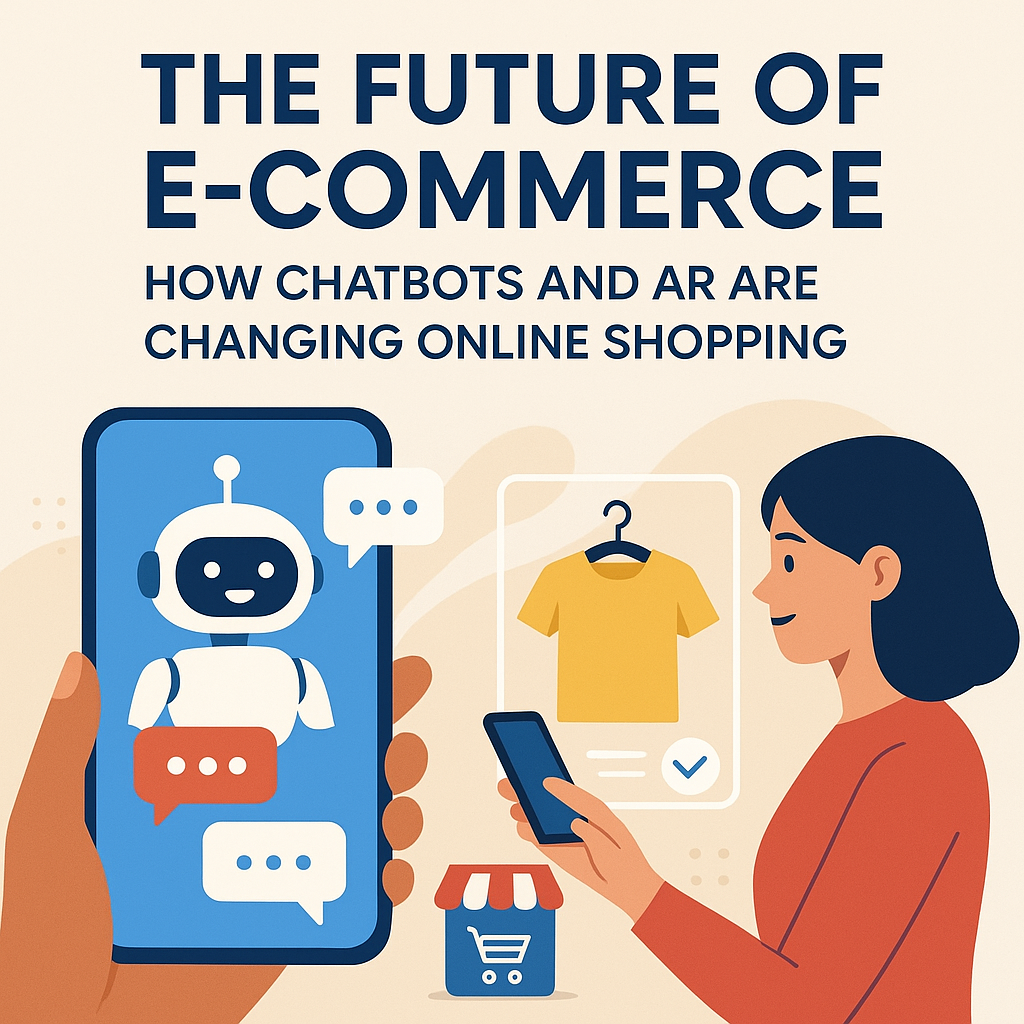
Online shopping used to mean browsing static product pages, reading a few images and a paragraph of copy, and hoping your purchase looked and felt like you expected when the package arrived. That model is changing fast. Two technologies conversational AI (chatbots) and augmented reality are reshaping the entire e-commerce experience, making it more immediate, guided, and immersive. Below I’ll walk you through how each technology matters, where they work best together, the business benefits, hurdles to watch for, and practical steps brands can take today to prepare for this future.
From questions to conversations: chatbots are the new shop assistants
Think of chatbots as the store associate who’s available 24/7, never gets tired, and remembers every product detail. Modern chatbots are far beyond the clunky scripted popups of a few years ago. They combine natural language understanding, contextual memory, and integrations with inventory, CRM and payment systems to:
. Answer product questions instantly. Shoppers want quick, accurate answers about fit, dimensions, compatibility, and delivery. Chatbots cut friction by giving clear responses without forcing a phone call or long email exchanges.
. Guide discovery. Rather than making a customer hunt through categories, a chatbot can ask a couple of simple questions (“What’s your budget? Any preferred style?”) and surface curated options — personal shopping on autopilot.
. Enable transactions. Conversational commerce allows people to add items to cart, choose variants, and even check out inside the chat window, reducing cart abandonment.
. Deliver proactive support. They can send shipping updates, answer returns policy questions, or recommend accessories based on purchase history.
. Scale personalization. Because a bot can access a user’s past behavior and preferences, it personalizes at scale something a single human assistant cannot.
AR: bring the product into the shopper’s world
Augmented Reality is the technology that overlays digital objects onto the real world and in e-commerce it solves a fundamental problem: customers can’t touch or try items before buying. AR reduces uncertainty by letting shoppers see how a product would look in their environment or on their person.
Key AR experiences that are already changing shopping behavior:
. Virtual try-on for fashion and accessories. Shoppers can see how sunglasses, hats, jewelry, or makeup look on their own face using the camera a huge trust booster for categories that rely on fit or aesthetics.
. Home visualization for furniture and decor. An AR app can place a sofa, rug, or lamp in your living room so you can check scale, color, and how it works with existing décor.
. Interactive product demos. Complex products (appliances, electronics, tools) can be shown in 3D with explorable features and animations that explain function better than a flat image or text.
. “See it in your space” social content. AR content is highly shareable users showing a virtual couch in their living room or a watch on their wrist becomes word-of-mouth marketing.
AR reduces returns, shortens the decision cycle, and importantly, increases shopper confidence. When people can visualize a product in context, they’re less likely to be disappointed.
When chatbots and AR combine: a powerful duo
Alone, chatbots and AR are transformative. Together, they multiply the effect. Imagine a conversational flow like this:
You message a brand’s chatbot asking for a bedside table recommendation. The bot asks two quick preference questions, shows three models, and one option includes an AR “place in your room” button. You tap it, use your phone camera to view the table in your bedroom, ask the chatbot if the wood finish is a warm or cool tone, and complete checkout within the chat all in a matter of minutes
. Guided AR try-on: A chatbot recommends items based on your answers and triggers an AR try-on, explaining fit and suggesting size adjustments in real time.
. Troubleshooting with a visual overlay: Customer support bots can ask the user to point their camera at a product; AR overlays can guide them through a simple fix or part replacement.
This integration blends decision support, visualization, and frictionless purchase into a single experience which is exactly what modern consumers expect.
in AR.. Personalized upsell within the visual context: After you place a virtual rug under a sofa, the chatbot suggests a throw pillow that complements the colors you’ve chosen, showing it
Business benefits: why retailers should careAdopting chatbots and AR can deliver measurable advantages:
Adopting chatbots and AR can deliver measurable advantages:
.Richer data for decisions. Interaction logs, visual engagement metrics (what AR assets customers view), and preference data inform merchandis. Higher conversion rates. Faster answers and immersive visualization reduce hesitation and increase purchases.
. Lower return rates. Better fit and context understanding means fewer surprises upon arrival.
. Reduced customer support overhead. Bots handle routine queries and triage complex ones to humans.
.Stronger brand differentiation. A seamless conversational + AR experience feels modern and premium it’s a competitive differentiatoring and product development.
Even small and medium brands can benefit: many platforms now offer plug-and-play chatbot and AR modules that integrate with common e-commerce stacks.
Challenges and ethical considerations
It’s not all sunshine. Brands adopting these technologies should be aware of some pitfalls:
. Accuracy and expectations. AR visualizations depend on good 3D models and accurate scale. Poor implementation can mislead shoppers and increase returns rather than reduce them.
. Privacy and data security. Chatbots often collect personal and transactional data; AR uses cameras. Clear consent, robust data handling, and transparent privacy policies are essential.
. Usability across devices. Not all customers have AR-capable devices or fast data connections. Experiences should degrade gracefully — e.g., provide a high-quality static image or size guide if AR isn’t available.
. Bias and accessibility. Conversational models must handle diverse ways of speaking and be accessible to users with disabilities. Voice and text interfaces need inclusive design.
. Cost and content production. Creating high-quality 3D assets, training bots, and integrating systems take time and budget.
Acknowledging these issues upfront and planning around them separates token implementations from truly effective ones.
Practical steps for brands (a short roadmap)
Prioritize use cases. Start where impact is highest — try-on for apparel/jewelry or “place in my room” for furniture.
1.If you’re a retailer wondering how to start, here’s a practical roadmap:
2.Choose the right partners. Many vendors offer SDKs and plug-ins for AR (WebAR, mobile SDKs) and chatbot platforms that integrate with Shopify, Magento, etc.
3.Build conversational flows, not scripts. Map customer journeys, including fallback routes to human agents. Test flows with real users to capture natural language variations.
4.Invest in a few high–quality 3D assets. You don’t need every SKU in 3D at first. Create 3–10 bestsellers in 3D and measure ROI.
5.Connect systems. Integrate with inventory, CRM, and payments so the chatbot can deliver accurate, actionable responses.
6.Measure and iterate. Track conversion, AR engagement, return rates, and average order value. Use data to expand what works
What shoppers want next
Consumers expect convenience, personalization, and sensory confidence from online shopping. That means:
. Faster conversations that actually resolve problems.
. Visual confirmation of fit and scale before purchase.
. Seamless cross-channel experiences — start a conversation on social, continue on web, finish on mobile in AR.
. Privacy and choice: explicit control over data sharing, with benefits for opting in (e.g., better personalization).
Brands that deliver these will win trust and loyalty.
A look ahead: 3 things to watch
1.More realistic AR and virtual try-on. As 3D capture and rendering improve, virtual try-on will look more true-to-life, including fabric drape and skin tone matching.
2.Voice + AR + commerce. Voice assistants combined with visual overlays could create hands-free shopping experiences imagine asking your home assistant to show you sofas and projecting them on your wall.
3.Cross-platform conversational commerce. Bots that remember context across channels (social, webchat, SMS) and can hand off to human agents smoothly will become table stakes.
Conclusion
Chatbots and AR aren’t gimmicks they’re fundamental shifts in how people discover, evaluate, and buy products online. Chatbots turn browsing into conversation, cutting through friction with personalized guidance. AR fills the sensory gap by letting customers see products in situ. Together, they create shopping journeys that are faster, more confident, and more delightful.
If you’re a retailer, the question is no longer whether to experiment, but how quickly you can design thoughtful, secure, and well-integrated experiences that meet your customers where they are. For shoppers, the future looks less like guesswork and more like trying before buying without leaving your sofa.